
A smarter MOB response
Safety solution
Man Overboard (MOB)
Detect. Locate. Respond.
When seconds matter, a connected system can save lives. Traditional MOB systems only raise an alarm. Ours links people, location, mustering and response coordination in one emergency management platform.
Time saving is life saving
Live position tracking
The casualty's last known position is plotted on a live map, with continuous updates where signal is available.
Drift prediction
Using environmental inputs, the system calculates a projected drift path to support recovery planning.
Rescue asset coordination
Nearby response assets can be shown with their distance and estimated time to reach the casualty.
Operational control and awareness
From detection to a coordinated response
The MOB module detects, activates and coordinates the emergency response when someone goes overboard, using real-time tracking, alarm management and accountability tools.
Automatic activation
MOB can be triggered automatically when an overboard event is detected. The system classifies it as a critical emergency and starts a coordinated response.
Casualty identified
Live persons-on-board and tracking data identify who is missing, so responders know immediately who is affected.
One incident view
Operators see personnel status, alerts and response progress in one real-time view.
Everyone else accounted for
Rapid POB validation and headcount checks confirm the remaining personnel, supporting faster decisions to escalate or stand down.
Connected
Part of your emergency response
Real-time alerting
Alerts go to operators and designated response teams, with a live incident view from activation to resolution.
Alarm and communication systems
MOB events can be linked to PAGA and other site-wide alarm systems, so the whole facility is notified at once.
Live muster integration
Mustering confirms the safety and status of everyone else on board during the incident.
In LocateAware
One view of the whole response
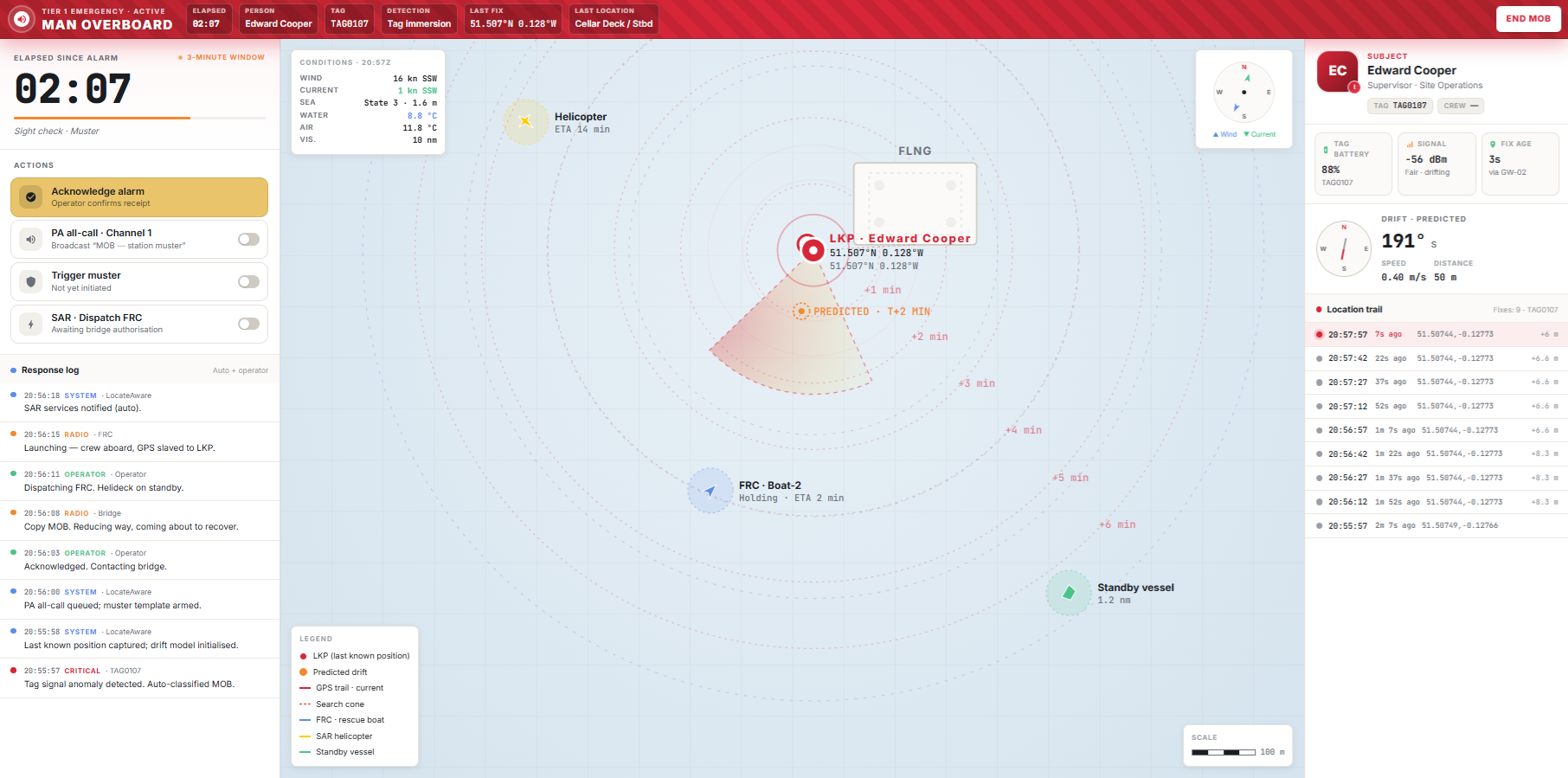
From the first alarm to recovery, the control room sees the casualty, the search area and every response asset on one screen.
Main features
- Alarm timer: time since the alarm, against a three-minute response window
- Casualty details: name, role and tag, with tag battery, signal and fix age
- Last known position: plotted on the map, with a live trail of location fixes
- Predicted drift: direction, speed and distance from wind, current and sea conditions, with a search cone
- Rescue assets: rescue boat, helicopter and standby vessel on the map, with their ETAs
- Operator actions: acknowledge the alarm, PA all-call, trigger a muster, dispatch the rescue boat
- Response log: every system, radio and operator action, time-stamped for review
See it in action
From splash to recovery
When a tag goes into the water, LocateAware raises the alarm, marks the last known position, predicts the drift and guides the rescue, while everyone else is mustered and accounted for.
- Detect: the alarm is raised automatically, and the casualty is identified by their tag.
- Locate: the last known position and a live trail of fixes, with the predicted drift.
- Respond: PA all-call, muster and the rescue boat, every action logged.
Illustration: a person on an FLNG falls overboard. The system raises the alarm, marks the last known position, tracks the drift and logs each action while the rescue boat recovers them. Use Simulate man overboard to play it.
Talk to us
Talk to an engineer, not a call centre.
Tell us about your site and your schedule. We'll come back with how the system would fit and what it would take.